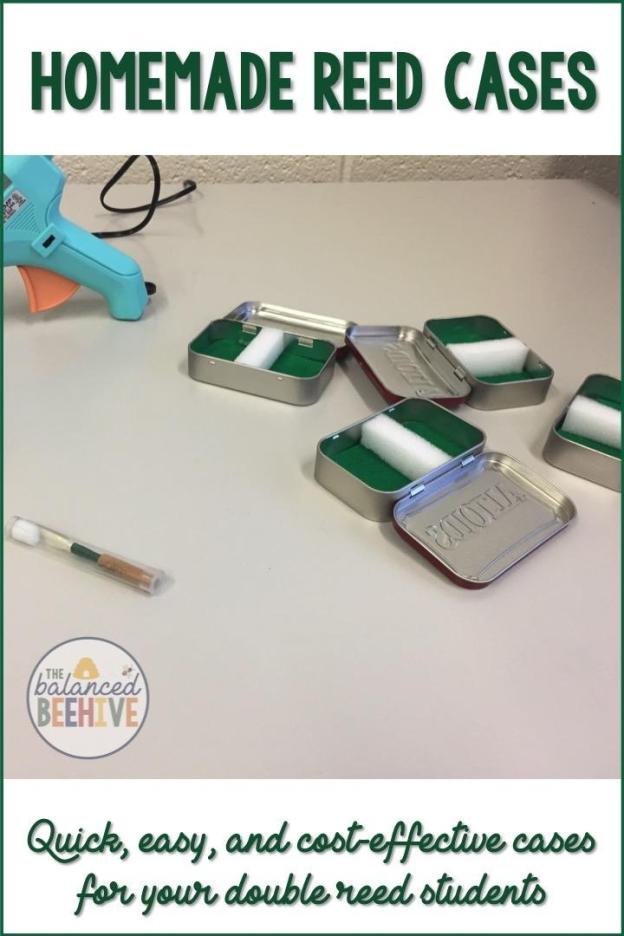
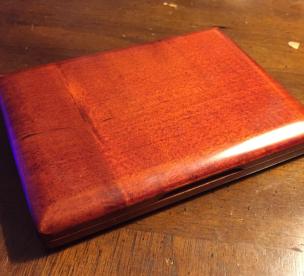
Growing up as a budding oboist, I vividly recall buying reeds that came in little plastic tubes or rectangular cases that, honestly, looked like little coffins. With oboe reeds generally costing much more than clarinet or saxophone reeds, it was always so important to keep them in playing condition for as long as possible in those early years. I’d like to think that I was pretty careful with my reeds as a 4th & 5th grader, but I’m sure some broke simply because I was using those tiny cases. I didn’t learn anything about reed making until I was in college, so that’s when I first bought myself a nice wooden multi-reed case – here it is in all its glory:

I believe it was also during my college years that I was introduced to the simple oboe reed case “hack:” creating one from an old Altoid container. I never ended up making one during college since I’d decided to buy a nice reed case, but after teaching band at the elementary level for three years, I finally decided to make some for my little oboists. This year, I teach four oboe students between my two schools, so it didn’t take much time to create these cases. Below are the materials and method if you’d like to make your own!
Homemade Oboe Reed Case
Materials required:
Altoid tin(s): I didn’t really plan ahead for purchasing the tins, and decided in the checkout line at the grocery store to throw in four containers of Altoids (cinnamon, if you’re curious). I probably could have been more cost-effective, but I paid $0.99 for each tin. All the Altoids are now in a new container in my kitchen.
Foam: I used a Foam Chair Pad from Hobby Lobby
Felt (any color): For lining
Hot glue gun: I have my own, but you could probably borrow from your art teacher
Scissors: For cutting the foam and felt
Razor blade: For putting slits into the foam
Ruler
Pen
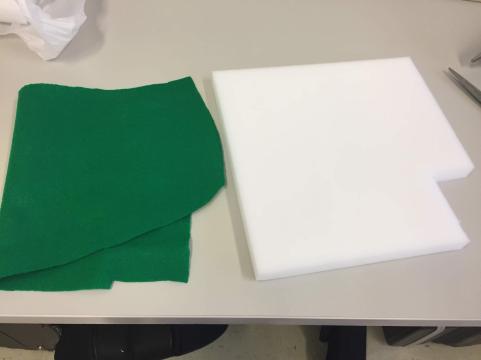
Felt and foam used for creating reed cases.
Procedure:
- Plug in hot glue gun.
- Measure and cut felt for lining. I both measured and traced for this step. I did use a ruler to measure the length and height of the Altoid tin so that I knew approximately how large to create the rectangles of felt to line the bottoms. However, since Altoid tins have curved edges and not corners, I decided to use a pen to trace the bottom of the tins. I cut one liner to see if it would fit nicely into the tin, and then made adjustments as necessary. After I finished measuring, tracing, and cutting, I had four rectangular ovals of felt.
- Glue felt liners into tins. This step was fairly simple, but I had to move quickly so that the glue didn’t dry between putting it on the felt and placing the felt into the tin. I made sure to completely cover the outer edge of the felt with glue so that it would stay down in the tin.
- Measure and cut the foam. Before starting, I knew that I wanted a simple strip of foam across the Altoid container. To decide the size of the foam strip, I first double checked my measurement across the container, then measured the height of the threaded part of my oboe reed. Last, I made sure that the foam was an appropriate height to fit completely inside the container when the lid is shut. I used both scissors and razor blade to cut and shape the foam strips.
- Glue foam strips into tins. I put hot glue on the bottom and sides of the foam strips to secure them in the tin. I tried to glue them exactly in the middle of the tin.

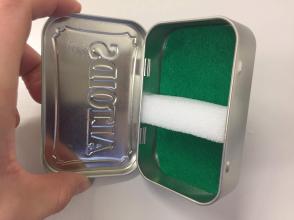
Altoid tins with felt liners and foam strips.
6. Use razor blade to cut slits in foam. I made three slits in each foam strip. I was careful to cut into the foam far enough that the reed would be snug, but not all the way down to the bottom – I wanted the foam to remain one long piece. I tested each slit in each reed case.
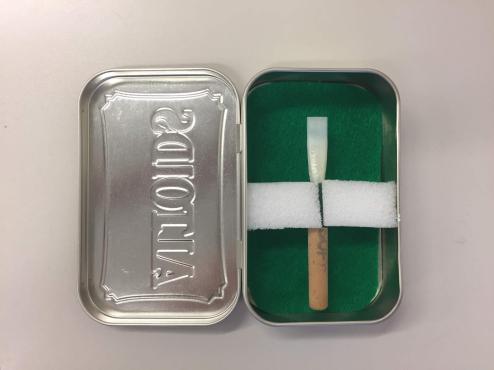
Reed in Altoid reed case.
***Please disregard my plastic reed – I have one on hand for emergency situations, but my students do purchase cane reeds.***
All in all, these reed cases took me 30-45 minutes to create, and I spent less than $10 on materials. It was definitely worth it to me to take the time and money to make these for my students so that they no longer need to deal with the frustration of those tiny little tubes. Learning the oboe is difficult enough without that exasperation! Best of all, it will save those families money on reeds because students will no longer break reeds trying to fit them into a small plastic case.
If you teach older students and have the time, this could be a fun group activity where students can assemble their own reed case. You could have students choose (or bring in) their own material for liners, and decorate the case however they like. They could even purchase their own Altoid containers so that you don’t need to put out any money. If I were doing this as a group activity with students, I would probably find an alternative to the razor blade for cutting into the foam, or maybe do that part at home myself.
Have you created cases for your double reed students? Let me know if you try this out and how it works for you and your musicians!

 Meg Elder, Beginning Band Teacher & Oboist