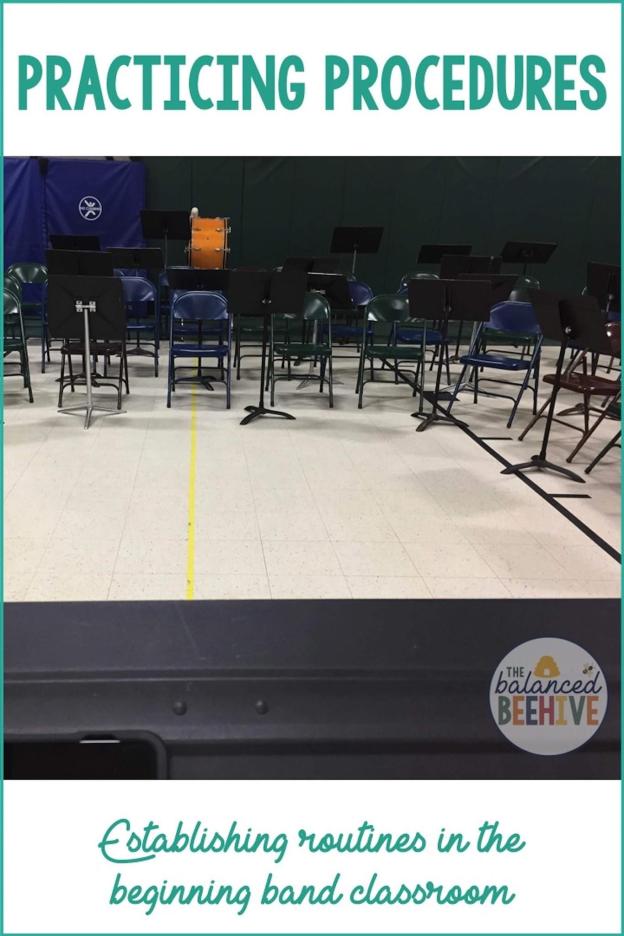
My band students are 9 and 10 years old. Sometimes it amazes me that at their age, they are able to carefully handle an instrument and everything that goes into learning how to play and maintain it. However, once the students have a handle on what to do with their instrument, they seem much more mature and responsible for being able to take care of it. When 4th and 5th graders have this kind of knowledge and responsibility, it can at times be easy to forget that the students ARE 9 and 10, and that they need very clear and consistent routines in the beginning band classroom. Your routines may change depending on whether you are teaching your full band or your small group lessons. Regardless, your students should be 100% sure of all routines in any situation so that your classes run as smoothly as possible. Here are the specific routines I’ve established with my students and the ways in which I reiterate those routines throughout the school year. I split up my explanations between full band rehearsal and small group lessons because these are very different classes for my program.
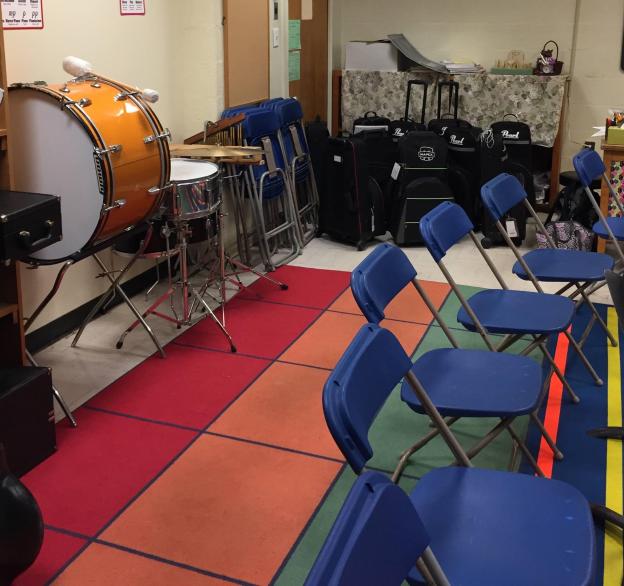
Routines for Arrival
Small group lessons
- Enter quietly – this year, my lesson schedule does not allow for transition time in between groups. Therefore, it’s very important for my students to enter the room quietly so as not to disrupt the lesson in progress. I also teach in small spaces, so this part of the arrival routine is very helpful to the flow of my teaching.
- Set up instrument – my students know that their first job upon entering the classroom is to put their instrument together. This is a longer task for some students than for others, so I make sure to reiterate that this is their FIRST task during the course of their lesson.
- Find their seat – my students understand that as they are coming in for their lesson, I am wrapping up with another group. Once the previous group has vacated, students will take their seat with their materials and move to the next step in the routine.
- Check the board – I will write the agenda and lesson objectives on the board, and from time to time have a specific activity for students to complete as a warm up. Since my students understand that this is part of their routine, we are able to begin more quickly.
- Warm up on their instrument – I kind of cheat with this part of the routine, because although I do instill in my students that they should always warm up before playing (including buzzing for brass players), I also write this instruction on the board to ensure that my students remember to include it in their arrival routine.
Full band rehearsal
- Set up instrument; keep all belongings together – my full band rehearsals occur before school, so students can come directly into the room and set up their instrument. We also have a specific place for all belongings to be stored in order to keep the room organized and avoid blocking any doorways.
- Sign in – because of the size of my beginning band, I always have a sign in sheet and a pencil on a music stand, in the same place for every rehearsal. Students know that they are responsible for signing in at rehearsal so that their attendance is counted for that day.
- Find their seat – some years I am very specific with seating and will have note cards on the chairs with student names. Other years, students may choose their seat as long as they sit within their section. Either way, students can find their seat easily.
- Warm up on their instrument – students warm up their instrument just like in small group lessons.
- Check schedule – for each concert season, I create a schedule that details which measures we will practice for each rehearsal. Part of my students’ arrival routine for full band rehearsals includes checking this schedule to remind themselves of what the rehearsal will entail.

Routines/Procedures During Class
Small group lessons
- Teacher will specify who plays and when – my students understand that I will give specific instructions for whether we will play as a group, or if students should play individually. I constantly reiterate that I will also count off before students are expected to play.
- Students must ask permission to leave the room – this might seem like a no-brainer, but at the beginning of the year I will inevitably have a student who, when arriving at their lesson, panics upon realizing that they have left materials in their classroom and immediately leaves to go retrieve them.
- Students may move about the room on their own (in some cases) – for example, I do not require my students to ask to get a tissue, or to leave their chair to retrieve supplies from their case (new reed, valve oil, etc.). I do, however, set clear boundaries on WHEN students should do so – not in the middle of playing music, or not when I’ve asked a question and am awaiting responses. Simply saying “now would be a good time to change reeds if necessary” during the course of a lesson will teach students the expectation.
Full band rehearsals
- Teacher will specify who plays and when – with a large group of students, this part of the procedure is incredibly important. From the beginning of the year, I practice moving my ensemble between “playing position” and “rest position” in response to my arms being in “conducting position” or at my sides. I also tend to give instructions more slowly and repeat more times during rehearsals, especially if I am only asking certain sections to play.
- Students must ask permission to leave their seat – because of the size of my band and the size of the room in which I hold rehearsals, I do not feel comfortable with students leaving their seats without my permission. This is mostly so that I am acknowledging their movement and that I have to pay attention to the fact that they are out of their seat. During rehearsal, with so many different things happening at once, it would be so easy to lose track of students if they moved around the room on their own.
- Students must ask permission to leave the room – with the previous procedural step, this might go without saying. However, I find that I need to say it to students – especially since the bathrooms and water fountain are right outside the door. I often reiterate this with students during rehearsal, reminding them that it is a safety issue – and since my rehearsals occur outside of the school day, I am solely responsible for their whereabouts at all times.
Routines for Dismissal
Small group lessons & full band rehearsals
- Wait to be dismissed before packing up – I’m sure many band directors (and teachers in other areas!) deal with this on a daily basis. When you begin speaking to wrap up your lesson or rehearsal, students begin packing up their instrument and materials, and inevitably miss what you’re saying. I have found that if you ask students to wait until you say a certain word or phrase (like “goodbye” or “thank you”), students will be more focused on your words so that they don’t miss that dismissal indicator.
- Clean instrument after every use – for woodwinds, this means swabbing out the instrument, and for brass this can be as simple as emptying their instrument using the water key. I constantly remind my students of the importance of maintaining their instrument to avoid costly repairs down the road.
- Move with a purpose – the time it takes a student to put their instrument away will vary depending on what instrument it is. However, some students will take their time with this step – either because they don’t want to go back to their classroom, or simply because they are not focused on doing so quickly. Sometimes, I turn putting their instruments away into a contest, and set a stopwatch to see who can put their instrument away the quickest (of course, they must clean it or else they are disqualified!).
The routines you establish for your young musicians will vary depending on your teaching space, program size, school environment and student personalities. Certainly, mine vary slightly from year to year, but I strive to keep them generally consistent, especially since many students return for a second year of playing. In the beginning of the school year, it can be difficult to establish routines in multiple spaces, and students will inevitably forget or mix them up or struggle to accept the new procedures. At times I need to remind myself that it is my responsibility to teach the routines at the beginning, and then practice, remind, and review those routines consistently with my students. If a student makes a mistake, I don’t get angry. Instead, I simply remind the student of the expectation and move on. If this happens 7 times in the same week, then I check myself to see if I’m meeting the expectations as well. It is so easy to get wrapped up in teaching new notes and rhythms, preparing for concerts, and making sure each student has the supplies they need. Sometimes we need to take a step back and revisit the basics – for your students’ benefit and for your own.

 Meg Elder, Beginning Band Teacher & Oboist